Honey Bees and
Beekeeping - An
Overview
Keith S. Delaplane, Extension Entomologist, University
of Georgia College of Agricultural & Environmental
Sciences
Honey Bee Biology
Races of Honey Bees

Preparing to Keep
Bees
Beekeeping Equipment
Buying and
Moving Colonies
Installing
Packaged Bees
Catching Swarms
Honey Bee Management
Processing Honey
Pollination
Stings
Honey Bee
Diseases and Pests
Unwanted Honey
Bee Colonies
--------------------------------------------------------------------------------
Overview
Honey bees (Apis mellifera L.) are one of the most
well-known, popular and economically beneficial
insects. For thousands of years, man has plundered
honey bee colonies to get honey, bee larvae and
beeswax. In recent decades, bee plundering has given
way to bee management. Now, honey bees are commonly
kept in artificial hives throughout the United States,
and a large and sophisticated beekeeping industry
provides valuable honey, beeswax and pollination
services. A large section of the industry, well
represented in Georgia, is devoted to mass-producing
queens and bees for sale to other beekeepers. Although
many people make a living from bees, most beekeepers
are hobbyists who have only a few hives and who simply
enjoy working with these fascinating insects.
Honey Bee Biology
Honey bees, like ants, termites and some wasps, are
social insects. Unlike ants and wasps, bees are
vegetarians; their protein comes from pollen and their
carbohydrate comes from honey which they make from
nectar. Social insects live together in groups,
cooperate in foraging tasks and the care of young, and
have different types, or "castes," of individuals.
There are three castes of honey bees (Figure 1):
Workers
- Reproductively underdeveloped females that do all
the work of the colony. A colony may have 2,000 to
60,000 workers.
Queen - A fully fertile female specialized for
producing eggs. When a queen dies or is lost, workers
select a few young worker larvae and feed them a
special food called "royal jelly." These special
larvae develop into queens. Therefore, the only
difference between workers and queens is the quality
of the larval diet. There is usually only one queen
per colony. The queen also affects the colony by
producing chemicals called "pheromones" that regulate
the behavior of other bees.
Drones - Male bees. A colony may have 0 to 500 drones
during spring and summer. Drones fly from the hive and
mate in the air with queens from other colonies.
  The
queen lays all her eggs in hexagonal beeswax cells
built by workers. Developing young honey bees (called
"brood") go through four stages: the egg, the larva
(plural "larvae"), the inactive pupa (plural "pupae")
and the young adult (Figures 2-6). The castes have
different development times (Table 1).

Newly
emerged workers begin working almost immediately. As
they age, workers do the following tasks in this
sequence: clean cells, circulate air with their wings,
feed larvae, practice flying, receive pollen and
nectar from foragers, guard hive entrance and forage.
Unlike colonies of social wasps and bumble bees, honey
bee colonies live year after year. Therefore, most
activity in a bee colony is aimed at surviving the
next winter.
During winter, bees cluster in a tight ball. In
January, the queen starts laying eggs in the center of
the nest. Because stored honey and pollen are used to
feed these larvae, colony stores may fall dangerously
low in late winter when brood production has started
but plants are not yet producing nectar or pollen.
When spring "nectar flows" begin, bee populations grow
rapidly. By April and May, many colonies are crowded
with bees, and these congested colonies may split and
form new colonies by a process called "swarming." A
crowded colony rears several daughter queens, then the
original mother queen flies away from the colony,
accompanied by up to 60 percent of the workers. These
bees cluster on some object such as a tree branch
while scout bees search for a more permanent nest site
- usually a hollow tree or wall void. Within 24 hours
the swarm relocates to the new nest. One of the
daughter queens that was left behind inherits the
original colony.
Table 1. Development time of honey bee castes.
Stage
Days after Laying Egg
Worker Queen Drone
Hatching
3 3 3
Cell capped
8 8 10
Becomes a pupa
11 10 14
Becomes an adult
20 15 22.5
Emerges from cell
21 16 24
After the swarming season, bees concentrate on storing
honey and pollen for winter. By late summer, a colony
has a core of brood below insulating layers of honey,
pollen and a honey-pollen mix. In autumn, bees
concentrate in the lower half of their nest, and
during winter they move upward slowly to eat the honey
and pollen (Figure 7; click on graphic for larger
view).
Races of Honey Bees
Honey bees are Old World insects that were introduced
into North and South America by European settlers. The
most well-known races of honey bees in the New World
are:
Italian bees (Apis mellifera ligustica) -
Originally from Italy, this is by far the most popular
honey bee. Italian bees are yellow in color,
relatively gentle, overwinter well and build up
quickly in spring. They are easily provoked to rob
weaker neighboring colonies and sometimes exhaust
honey stores rapidly in winter.

Carniolan bees (Apis mellifera carnica) - These
bees originated in the Austrian Alps, northern
Yugoslavia and the Danube valley. Gray/brown in color,
they are extremely gentle, conserve winter food stores
well and build up quickly in spring. Carniolan bees
construct new comb slowly and swarm frequently.
Caucasian bees (Apis mellifera caucasica) -
These bees originated in the Caucasus mountains
between the Black and Caspian Seas. They are lead-gray
in color, very gentle and swarm infrequently.
Caucasian bees overwinter poorly, build up slowly in
spring, are susceptible to Nosema disease and gum up
their hives with propolis (tree resins and beeswax).
German black bees (Apis mellifera mellifera) -
Originally from throughout northern Europe, this was
the first honey bee brought to the New World. They are
brown/black in color and overwinter well. German black
bees are nervous, aggressive and build up slowly in
spring.
Africanized honey bee (Apis mellifera
scutellata) - These honey bees originated throughout
east Africa. In the 1950s, this race was imported to
Brazil and began migrating northward. Compared to
European races, this bee and its hybrids are extremely
defensive, have smaller nests and swarm more
frequently. Africanized honey bees will probably
colonize certain regions of the United States in the
1990s.
Preparing to Keep
Bees
Honey bees can be kept almost anywhere there are
flowering plants that produce nectar and pollen.
Choose a site for bee hives that is discrete,
sheltered from winds and partially shaded. Avoid low
spots in a yard where cold, damp air accumulates in
winter. Your county Extension agent can give you names
of local beekeepers and bee organizations that are
sources of help and information.
Be considerate of non-beekeeping neighbors. Place
hives so that bee flight paths do not cross sidewalks,
playgrounds or other public areas. In dry weather,
bees may collect water at neighbors' swimming pools or
water spigots. Avoid this by giving your bees a water
source in your yard such as a container with floating
wood or Styrofoam chips. The floating objects prevent
bees from drowning.
Beekeeping Equipment
One new hive with bees and basic equipment costs about
$150. Hive parts are cut to standard dimensions that
mimic the space bees naturally leave between their
combs. Always reproduce these dimensions exactly if
you make your own bee hives. You will need the
following equipment.

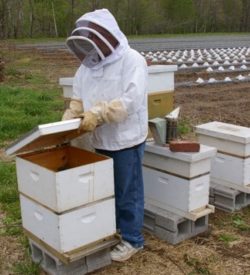
Bee hive (Figure 8; click on graphic for larger
version), made up of:
Bottom board - wooden stand on which the hive
rests. Set bottom board on bricks or concrete blocks
to keep it off the ground.
Frames and foundation - wooden frames that hold
sheets of beeswax foundation that is imprinted with
the shapes of hexagonal cells. Bees use the foundation
to build straight combs.
Hive body or brood chamber - large wooden box
(called a "super") that holds 10 frames of comb. This
space (the brood nest) is reserved for the bees to
rear brood and store honey for their own use. Either
one or two hive bodies can be used for a brood nest.
Two hive bodies are common in cold winter regions.
Beekeepers in areas with mild winters successfully use
only one hive body.
Queen excluder - placed between the brood nest
and the honey supers. This device keeps the queen in
the brood nest, so brood will not occur in honey
supers. An excluder is usually not necessary if two
hive bodies are used.
Honey Boxed (called "supers") - shallow supers
with frames of comb in which bees store surplus honey.
This surplus is the honey that is harvested.
Inner cover - prevents bees from attaching comb
to outer cover and provides insulating dead air
space.
Outer cover - provides weather protection.
Smoker - the most valuable tool for working
bees. A smoker calms bees and reduces stinging. Pine
straw, grass and burlap make good smoker fuel.
Hive tool - ideally shaped for prying apart
supers and frames.
Veil and gloves - protect head and arms from
stings. After they gain experience, most beekeepers
prefer to work without gloves.
Feeders - hold sugar syrup that is fed to bees
in early spring and in fall.
Exterior wooden parts should at least be coated with
good oil base paint. To maximize the life of exterior
parts, first dip them in copper naphthenate wood
preservative, then paint them. Assemble interior
frames with wood glue and nails.
Buying and Moving
Colonies
The easiest, and sometimes the best, way to start
keeping bees is to buy two established colonies from a
reputable local beekeeper. Buying two colonies instead
of one lets you interchange frames of brood and honey
if one colony becomes weaker than the other and needs
a boost. Before buying, arrange to inspect the
colonies. Ask the seller to provide a recent
certificate of inspection from the state Department of
Agriculture. Buy bees in standard equipment only.
Competent beekeepers usually have one or two hive
bodies on the bottom board with shallower honey supers
above. Question the seller if supers are arranged
differently. The condition of the equipment may
reflect the care the bees have received, so be
suspicious of colonies in rotten, unpainted wood. Once
the colony is opened, the bees should be calm and
numerous enough that they fill most of the spaces
between combs.
Be sure each super has at least nine frames of comb.
Inspect combs in the deep supers for brood quality.
Capped brood is tan - brown in color. A good queen
will have at least five or six combs of brood, and she
will lay eggs in a solid pattern so that there are few
skipped cells. Look for symptoms of brood disease and
wax moth larvae (see the section on "Honey Bee
Diseases and Pests").
Bee hives are easiest to move during winter when they
are lighter and populations are low. Moving hives is a
two-man job. Close the hive entrance with a piece of
folded window screen, seal other cracks with duct
tape, fasten supers to each other and to the bottom
board with hive staples then lift the hive into a
truck bed or a trailer. Tie the hives down tightly.
Remember to open hive entrances after the hives are
relocated.
Installing Packaged
Bees
Another way to start keeping bees is to buy packaged
bees and queens and transfer the bees into new
equipment. Bees are routinely shipped in two to five-
pound packages of about 9,000 to 22,000 bees. Once
your packages arrive, keep the packages cool and
shaded. Set up a bottom board with one hive body and
remove half its frames. Make some sugar syrup (one
part sugar:one part water) and spray the bees heavily
through the screen; bees gorge themselves with syrup
and become sticky, making them easy to pour. Pry off
the package lid, remove the can of syrup provided for
transit, find and remove the queen suspended in her
cage and re-close the package. The queen cage has
holes at both ends plugged with cork, and one end is
visibly filled with white "queen candy." Remove the
cork from this end and suspend the queen cage between
two center frames in your hive. Workers will eat
through the candy and gradually release the queen.
Next, bounce the package lightly to shake all bees
into a clump on the bottom, quickly take off the lid
and shake the bees into the hive on top of the queen.
As the bees slowly spread throughout the hive, gently
return the frames you removed earlier. Carefully place
the inner and outer covers on your new colony and feed
your bees sugar syrup continuously until natural
nectar flows begin. After two days, check to see if
the bees have released the queen from her cage. If she
was released, you will probably find her slowly
walking on one of the center combs. If bees have not
yet released her, return the queen cage to the hive
until she is released. A week after the queen's
release, check the colony again. By this time, you
should find white wax combs under construction with
cells containing syrup, eggs or young larvae. If you
do not find eggs, the queen may be dead and she must
be replaced immediately. Order another queen and
introduce her as before.
Catching Swarms
Another way to get started is by finding and
installing swarms. Sometimes swarms cluster on
accessible places such as low tree branches, and
property owners are usually eager for a beekeeper to
remove them. If you find a safely accessible swarm,
get a five-gallon plastic bucket with some kind of
perforated cover such as window screening. Spray the
swarm heavily with sugar syrup, place the bucket
underneath it then give the branch a sharp shake to
dislodge bees into the bucket. Cover the bucket and
install the swarm in a hive as you would packaged bees
(except for the steps on installing a caged queen).
Your county Extension agent will be glad to take your
name as a referral for swarm calls.
Honey Bee Management
Management is scheduled around natural nectar flows.
Beekeepers want their colonies to reach max-imum
strength before the nectar flows begin. This way, bees
store the honey as surplus that the bee-keeper can
harvest instead of use the honey to com-plete their
spring build-up. Nectar flows are very different
between north and south Georgia (Table 2) so plan your
beekeeping tasks according to the nectar flows in your
area.
Feeding and medicating should be done January through
February. Queens resume laying eggs in January after
which brood production accelerates rapidly to provide
the spring work force. Some colonies will need
supplemental feeding. If colonies are light when you
hoist them from the rear, they need sugar syrup. Mix
syrup (one part sugar:one part water) and feed the
bees heavily. Commercially available pollen
supplements provide extra protein for population
growth. Feed all medications (see the section on
"Honey Bee Diseases and Pests") early enough to allow
for labeled withdrawal periods before nectar flows
begin.
By mid-February, the hives are ready for detailed
inspection. On warm days (at least 45 degrees F) check
the colonies for population growth, the arrangement of
the brood nest and disease symptoms. Colonies with
less brood than average can be strengthened by giving
them frames of sealed brood from stronger neighbors.
If you use two hive bodies, most of the bees and brood
may be in the upper body with little activity in the
bottom one. If so, reverse the hive bodies, putting
the top one on the bottom. This relieves congestion
and discourages swarming. If you use one hive body,
relieve congestion by providing honey supers above a
queen excluder. Swarming should be avoided because it
severely reduces colony strength.
Mail-order queens are usually available by the last
week in March. Annual requeening, whether in early
spring or in fall, is one of the best investments a
beekeeper can make. Compared to older queens, young
queens lay eggs more prolifically and secrete higher
levels of pheromones which, in turn, stimulate workers
to forage, suppress swarming and suppress disease
outbreak. To requeen a colony, find, kill and discard
the old queen. Let the colony remain queenless for 24
hours then introduce the new queen in her cage as
described in the section "Installing Packaged Bees."
With a new queen, you can also make a new colony by
taking frames of brood, honey and bees from a strong
colony (leaving behind the old queen), placing them in
a new hive body with a new queen then moving the new
hive to a new location. This controlled "splitting" of
a colony lets a beekeeper manage the swarming process;
congestion and the swarming urge are relieved in the
strong colony, and the removed bees are housed in a
managed hive instead of lost.
If you feed your colonies, medicate them, requeen them
and control swarming, they should be strong enough to
collect surplus nectar by mid-April. This is the time
to add honey supers above the hive bodies. Add plenty
of supers to accommodate incoming nectar and the large
bee populations; this stimulates foraging and limits
late-season swarming. As nectar comes in, bees place
it in cells and evaporate it to about 18 per-cent
water content. When bees cap the honey, it is
considered ripe. At harvest time, use commercially
available bee repellents to drive bees from the
supers.
Not all honeys are alike. Usually, lighter honeys
command higher prices, and most beekeepers try to keep
darker honeys from mixing with lighter ones. For
example, beekeepers in north Georgia remove supers
with dark tulip poplar honey before it can mix with
incoming sourwood honey which is lighter. Consult
Table 2 and local beekeepers to determine the proper
time to remove your honey.
During late summer and early autumn, brood production
and honey production drop. Unlike in spring, you
should now crowd the bees by giving them only one or
two honey supers. This forces bees to store honey in
the brood nest. Colonies are usually overwintered in
two hive bodies or in one hive body and at least one
honey super. If you overwinter in one hive body and a
honey super, remove the queen excluder so the queen
can move up into the honey during winter. Colonies
should weigh at least 100 pounds in late fall. If they
are light on stores, feed them a heavy syrup (two
parts sugar:one part water).
Processing Honey
Honey is sold as "extracted" honey - bottled, liquid
honey that has been extracted from the combs; "comb"
honey -honey still in its natural comb; and "chunk"
honey - a bottled combination of extracted and comb.
Honey extracting equipment for the hobbyist is
specialized and represents a one-time investment of
about $500 for new equipment. Used equipment is often
available at significant savings. These are the basic
tools and procedures for extracting honey:
Uncapping knife - A heated knife for slicing
off the cappings from combs of honey.
Uncapping tank - A container for receiving the
cappings. Wet cappings fall onto a screen, and honey
drips through to the bottom of the tank and out a
spigot.
Extractor - A drum containing a rotating wire
basket. Uncapped combs are placed in the basket and
the basket is turned by hand or by motor. Honey is
flung out of the combs onto the sides of the tank and
drains through a spigot.
Strainer - A mesh of coarse screen or cloth
directly under the extractor spigot. This filters out
large debris such as wax and dead bees.
Storage tank - A large tank with a spigot, or
"honey gate," at the bottom. As honey settles in the
tank, air bubbles and small debris rise to the top and
can be skimmed off, allowing honey that is bottled
from the honey gate to be clear and attractive.
Sometimes extracted honey granulates. This is a
natural process, and the honey is still perfectly
edible. If bottled honey granulates, loosen the lid
and place the jar in a pan of water on a stove. Heat
and stir the honey until it re-liquefies.
Comb honey requires little specialized equipment, so
it is a good way for a new beekeeper to get started.
Supply companies offer special comb honey supers for
producing comb honey in round or square one-pound
sections. "Cut-comb" honey is the easiest and least
expensive honey to produce. With cut-comb, the entire
comb is cut away from the frame then further cut into
smaller sections and packaged in special plastic
boxes. Regardless of these variations, all comb honey
requires special extra-thin foundation. Freeze comb
honey overnight before it is sold to kill any wax moth
eggs and larvae.
Chunk honey is made by placing a piece of cut comb
honey in a jar and filling up the rest of the jar with
extracted honey. Remember to freeze the comb honey
first.
Wax cappings are a valuable by-product of extracting.
After cappings have dripped dry, wash them in water to
remove all honey. Melt the cappings, strain the wax
through cheesecloth and pour it into bread pans or a
similar mold. Supply companies can render your beeswax
bricks into new foundation at considerable savings.
Pollination
Many valuable crops benefit from insect pollination
(the transfer of pollen from one flower to another
flower). This process increases fruit yield and,
often, the size of the fruit. Honey bees are important
pollinators because they can be managed and easily
moved to crop sites. In the United States, the added
value to agriculture from honey bee pollination is
over $9 billion annually, and many beekeepers earn
extra income from renting colonies for pollination. In
Georgia, bee hives are rented to pollinate apples,
blueberries, cucumbers and watermelons. Professional
recommendations vary for the number of hives needed
for good pollination, but for these crops one colony
per acre is commonly used.
Stings
Anyone who keeps bees will inevitably get stung.
Consider this before you invest in a beekeeping hobby.
You can greatly reduce stinging if you use gentle,
commercially reared queens, wear a veil, use a smoker
and handle bees gently. Experienced beekeepers can
handle thousands or even millions of bees daily and
receive very few stings.
A bee sting will cause intense local pain, reddening
and swelling. This is a normal reaction and does not,
in itself, indicate a serious allergic response. With
time, many beekeepers no longer redden or swell when
they are stung (however, it still hurts!). An
extremely small fraction of the human population is
genuinely allergic to bee stings. These individuals
experience breathing difficulty, unconsciousness or
even death if they are stung and should carry with
them an emergency kit of injectable epinephrine,
available by prescription from a physician.
When a bee stings, the stinger and poison sack remain
in the skin of the victim. Always scrape the stinger
and poison sack out of the skin with your fingernail
or a hive tool (Figure 9); never pull it out because
this squeezes the remaining venom into the skin.
Honey Bee
Diseases and Pests
Honey bee brood and adults are attacked by bacteria,
viruses, protozoans, fungi and exotic parasitic mites.
Additionally, bee equipment is attacked by other
insects. Disease and pest control requires constant
vigilance by the beekeeper. By law, all colonies in
Georgia must be registered with the Georgia Department
of Agriculture. Every beekeeper is responsible for
contacting the Department for an inspection at least
once every 18 months (every 12 months for queen and
package bee producers). See your county Extension
agent for help in registering and inspecting your
hives.
American foulbrood (AFB) is a bacterial disease
of larvae and pupae. The bacteria form highly
persistent spores that can be spread by adult bees and
contaminated equipment. Infected larvae change color
from a healthy pearly white to dark brown and die
after they are capped. Cappings of dead brood sink
inward and often are perforated. Check for AFB by
thrusting a small stick or toothpick into the dead
brood, mixing it then withdrawing the mass. Brood
killed by AFB will be stringy and rope out about inch.
Colonies with AFB must be burned by a state bee
inspector. The State of Georgia pays beekeepers a
monetary compensation to help replace the loss. To
prevent AFB, feed colonies the antibiotic Terramycin®
according to label instructions in early spring and
fall. Allow at least four weeks from the last
Terramycin® treatment until the first nectar flow.
European foulbrood (EFB) is a bacterial disease
of larvae. Unlike with AFB, larvae infected with EFB
die before they are capped. Infected larvae are
twisted in the bottoms of their cells, change to a
creamy color and have a smooth "melted" appearance.
Because EFB bacteria do not form persistent spores,
this disease is not as dangerous as AFB. Colonies with
EFB will sometimes recover on their own after a good
nectar flow begins. To prevent EFB, treat colonies
with Terramycin® as described above.
Chalkbrood is a fungal disease of larvae.
Infected larvae turn a chalky white color, become hard
then turn black. Chalkbrood is most frequent during
damp conditions in early spring. Colonies usually
recover on their own.
Nosema is a widespread protozoan disease of
adult bees and is especially common in north Georgia.
In spring, infected colonies build up very slowly or
not at all. Bees appear weak and may crawl around the
front of the hive. Discourage nosema by selecting hive
sites with good air flow. Damp, cold conditions seem
to encourage this disease. Treat nosema by feeding the
drug Fumidil® B in sugar syrup in spring and fall. Do
not feed the medication immediately before or during a
nectar flow.
Wax moths are a notorious pest of beekeeping
equipment. Adult moths lay eggs near wax combs, then
their larvae hatch and begin burrowing through the
combs to eat debris in the cells. Moth larvae ruin
combs and plaster them with webbing and feces. Honey
bees are usually very good at protecting their
colonies from moth larvae. If moth damage is found in
a colony, there was some other problem (usually queen
loss) that weakened the colony first. Moth damage is
most common in stored supers of comb. Protect stored
supers by stacking them no higher than five hive
bodies. Tape shut all cracks, put paradichlorobenzene
crystals at the top of the stack and cover the stack
with a lid. Replenish the crystals as they evaporate.
Tracheal mites were first detected in Georgia
in 1986 and have since caused high colony death rates
throughout the state. The microscopic mites enter the
tracheae (breathing tubes) of young bees. Inside the
tracheae, mites block air exchange and pierce the
walls of the tubes to suck blood. Symptoms resemble
those of nosema. Bees become weak, crawl at the hive
entrance and sometimes uncouple their wings so that
all four wings are visible. Colony death rates are
highest during winter and early spring. If you suspect
tracheal mites, see your county Extension agent for
help in diagnosing the disease. Infested colonies are
treated with Miticur® or special formulations of
menthol.
Varroa mites were first found in Georgia in
1989. These mites are about the size of a pin head and
are copper in color. Female mites cling to adult bees
and suck their blood. Females then enter a bee brood
cell and produce several offspring which, in turn,
suck the blood of the developing bee. Infested
colonies almost always die within three to four years
unless they are treated. Colonies are treated with
Apistan®, a formulation of fluvalinate. Because
tracheal mites and Varroa mites are newcomers to the
United States, control technology is rapidly changing
and has not been well worked out. See your county
Extension agent for the latest information on mite
control.
Unwanted Honey Bee
Colonies
When honey bees swarm and establish new colonies, they
often move into hollow trees or voids inside walls of
houses. Non-beekeepers are not accustomed to the sight
of natural bee colonies, and they may react toward
them with fear and hostility. Beekeepers are
frequently asked to rid someone of unwanted bee
colonies.
Someone with a natural bee colony should first decide
if a problem truly exists. Honey bees, even those in
walls of houses, do not cause any structural damage.
Bees high in a tree or in the walls of an upper story
are usually so far removed from people that there is
virtually no chance of stinging. Unless people
directly encounter the bees, the property owner should
consider them an interesting opportunity to study
nature!
If you decide to eradicate honey bees from a wall
void, be prepared to pay for the services of an
experienced beekeeper and a carpenter. To permanently
solve the problem, the entire nest and the bees must
be removed and the entrance resealed. It is not enough
to simply spray inside the nest entrance with an
insecticide because after the insecticide degrades,
the cavity and combs are attractive to future swarms
of bees. Moreover, if bees in a wall are killed but
the nest is not removed, the combs are no longer
ventilated and wax and honey may melt and stain
interior walls. An experienced beekeeper can expose
the nest and remove the bees and comb. The property
owner is responsible for hiring a carpenter to reseal
the void.
Table 2. Major pollen & nectar sources
Month
Plant Provides
February
maple pollen, nectar
March
dandelion pollen
April black
locust nectar
April - June
clover nectar
April - May tulip
poplar nectar
June - July
sourwood nectar
September
goldenrod pollen, nectar
---------------------------------------------------------------------------
|