|
|
 |
Lean-to Shelter Construction
by Glen Monaghan

- Lean-to Shelter Construction
by Glen Monaghan
One question that we frequently hear at our classes
is, "What size should my lean-to shelter be?"
MINIMIZE YOUR EFFORT
My general outlook on ANY shelter is to minimize my
time and energy expenditure for building and using
it as much as can be safely and practically done. A
smaller shelter is quicker and easier to build than
is a larger shelter. This is especially true when
precipitation and/or low temperatures call for more
robust construction. Furthermore, body heat and/or a
smaller fire works better with a smaller lean-to, so
it takes less effort to stay comfortable than in a
larger shelter.
A larger lean-to, with greater volume and longer
distances between the fire and your body or roof,
requires a significantly larger fire (and so
gathering more firewood) than you would need for
equivalent warmth with a smaller lean-to. If you
make a larger lean-to but then scoot all the way to
the back of it in order to minimize overhead air gap
and improve reflective radiant heating off the back
wall, you also have to scoot farther out of your
warm sleeping spot every time you have to tend the
fire, losing more body heat and further disturbing
your already disrupted sleep. Then, you have to
scoot back and rearrange your now-cooled bedding. A
larger shelter will also require you to gather a lot
more firewood if you have any hope of keeping your
"lean-to mansion" warm. Not having to gather that
extra quantity of wood needed for an oversized
shelter is a real plus in ANY situation, whether
it's survival or recreational camping.
LOWER IS BETTER
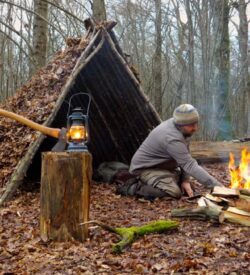
I advocate making a shelter as small as possible.
The rule of thumb that I typically give is, "Make
the cross beam (ridge pole) closer to knee high than
waist high." With a suitable mattress (layer of
debris) for insulation from the ground, actually
making it knee high probably won't provide quite
enough overhead clearance, while waist high is way
overkill. However, that guideline is based on the
assumption that you are primarily interested in
building an efficient shelter for sleeping.
"ADD-ON" ROOM OPTION
If it's important to you to have a space where you
can sit upright in your lean-to yet be protected
from precipitation, you would probably need to make
the ridge even higher than waist high. Try one and
see... you need to have the ridge high enough to sit
upright without hunching over (unless your back is
much better than mine), yet with enough overhang in
front of you to keep you out of the rain or snow.
Plus, if you want to have a fire when you are
sitting near the front like that, then you have a
problem. Either you have to put your "sitting fire"
too far back for use when sleeping, or you have to
keep it very small so as not to cook yourself while
sitting, but then build it up a fair bit to stay
warm when sleeping closer to the back of the
shelter, burning more wood all night. And the large
open space in the shelter behind you makes your back
feel noticeably cool when sitting in a large
lean-to.
So, if I found myself in a situation where I really
needed or wanted to sit up in wet weather (such as
to burn out a bowl, make cordage, carve trap
triggers, etc.), I'd definitely consider making a
small sleeping shelter initially, and then come up
with some sort of adjoining extension sized
specifically for sitting and working. Even better
than making it, locate a suitable ready-made
sitting/working site, like beneath a fir tree where
you can have a ready made roof (the fir boughs),
ground pad (several inches of old needles that have
fallen), and a backrest (the trunk). It's quicker
and easier to add a windbreak (if needed) to such a
ready-made waterproof roof than it is to make a
waterproof lean-to that is big enough to sit under.
DON'T MAKE THIS MISTAKE....
Another
common mistake is that people think that they want
to sit up in their shelter so they can cook and eat
at the fire they build there. Remember, food
preparation, cooking, and eating should be done well
away from your sleeping area. Any food and clothes
that smell of blood, guts, food, or cooking should
also be stored away from your sleeping area as well.
This is to discourage night time visits by critters
such as raccoons or predators that may smell the
food and try to get it from your shelter while you
are sleeping. You really don't want wild animals in
your shelter fighting with each other (or you) for
your food.
These recommendations are guidelines to give you a
starting point. The only way to really know how big
or small to make a lean-to that is right for YOU is
to build several in a variety of conditions to see
what works best for you.
RECAP of RECOMMENDATIONS
Build a lean-to, meant primarily for sleeping,
closer to knee high than waist high." This will...
- Minimize time and energy expenditure in building a
shelter
- Make it quicker and easier to build than a larger
shelter
- Allow more effective use of body heat and/or a
smaller fire for keeping warm.
A larger shelter, with its greater volume and longer
distances between fire and body/roof, needs more
heat for equivalent warmth.
Using a larger fire with a larger shelter means
gathering a lot more firewood than needed for a
smaller fire with a smaller shelter.
A smaller shelter requires less time, less work,
less fire wood, and will "feel" more cozy and
secure.
Consider having separate shelters for sleeping and
sitting/working, and don't prepare food, cook, or
eat in your sleeping shelter.
© 2010 MNSI - All rights reserved.
|
|
|
|
|
Printer
friendly version of this page
|
|