We teach you what you need to know to be comfortable and confident in the woods and more self reliant at home


MNSI Site Search


Bill Qualls Article
 
Midwest Native Skills Institute
by Bill Qualls
Photos by Bill Qualls

Download this article as a PDF file

Over the past thirty-one years I have had the privilege of attending a number of survival courses in five different states. I consider myself a student of survival skills, and as such I am always looking for opportunities to learn more. It is with this intent that I attended the June 15-17, 2007 offering of the Midwest Native Skills Institute’s Wilderness Survival Weekend course.

I registered for this course through the school’s website. Shortly thereafter I received an e-mail from the school’s owner and principal instructor, Tom Laskowski, asking me if there was anything in particular that I wanted to learn. I thought this personal attention was a good sign. I told Tom of my background and told him that when I attended a course such as this, if I see one new place, meet one new person, and take home one new skill then I consider the weekend to be a success. The weekend was, indeed, a huge success.

This class was held in Wayne National Forest southeast of Columbus, Ohio. Ten students attended the course. There were eight males and two females; ages ranging from 11 to 50.

Tom has clearly given a lot of thought to how to teach. He makes extensive use of mnemonics. For example, when you are lost, think of LIFE:
Logically assess your situation
Inventory what you have with you
Formulate a plan
Enact that plan

Of course, the LIFE acronym is applicable in life as well as in survival! Tom also made use of little rhymes. For example:
Wind from the west, weather at its best;
Wind from the south, water in the mouth;
Wind from the east, the weather is a beast;
Wind from the north, weather at its worst.
Kinda corny, but it worked! Our youngest student, Dominick, age 11, could recite all of Tom’s sayings.

Tom wanted everyone to experience success in this course. He is also sensitive to time constraints. So rather than spend what little time we had together gathering native materials to construct our own bow drill sets, he provided completed kits for student use. Consequently everyone in the class was able to experience success in starting a fire with the bow drill. (Only two of the ten students had done so before this weekend.) Likewise, everyone was able to start a flint and steel fire.

Some may take exception with Tom’s practice of providing his students with perfect materials, but I think it is appropriate in the context of his school’s curriculum. Tom said he teaches the same skills in his advanced course, but those students use native materials. For example, students will construct their own bow drill kits. Two more examples: in this course Tom provided dowels for students to use in carving figure-four deadfall traps, whereas in the advanced course they used tree branches. In this course the group worked together to build a debris hut, whereas in the advanced course each student built his own debris hut and slept in it.

People who are new to survival are often reluctant to eat wild plants. Tom had a solution for that too. For one of our snack breaks, Tom provided a bag of purslane and a block of mozzarella cheese. Both were chopped and melted in a frying pan, then used as a dip for Triscuit crackers. Yum!

On Saturday night we did a Blind Drum Stalk. I will not go into the details as to what this is. Suffice to say I was skeptical, but did my best to approach it with an open mind and was pleasantly surprised.

Topics discussed over the weekend included what to do when lost (LIFE); survival priorities (rule of threes); knife sharpening; knots; “slippery” knots; lashings; fire lays; one match fire; making char cloth; flint and steel fire; bow drill fire; other fire making techniques; poncho shelter; lean to shelter; debris hut; edible plants; water purification; navigation; weather; signalling; and survival kits.
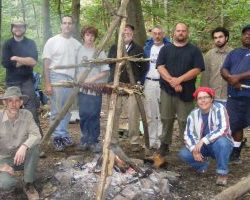
This was not a “hard core” course. Those courses have their place, but this was not one of them. Students bring their own tents and sleeping bags, and Tom provided plenty of food to eat. The success of Tom’s approach is shown in the faces of his students in the class photo. Those are happy faces. The students are proud without being puffed up.

For more information on the Midwest Native Skills Institute see http://www.survivalschool.com
Visit the author’s website at http://www.billqualls.com


Survivors (l to r) First row: Dominick.
Second row: Adam (assistant instructor),
Michael, Rob, Beth, Laura.
Third row: Gert, Tom, Marshall, Joe,
and Jan.


Eleven year old Dominick ties the
bottle knot.


Tom Laskowski making stick bread.


You never forget your first ash cake!


Michael’s one-match fire is a success.


The class works together to build a
debris hut.


Beginning to cover the ribs with debris.


Laura in the finished debris hut.


Joe coaxes his coal into a flame.
Success!


Beth makes a dip of chopped purslane
and mozzarella cheese.

Printer friendly version of this page